
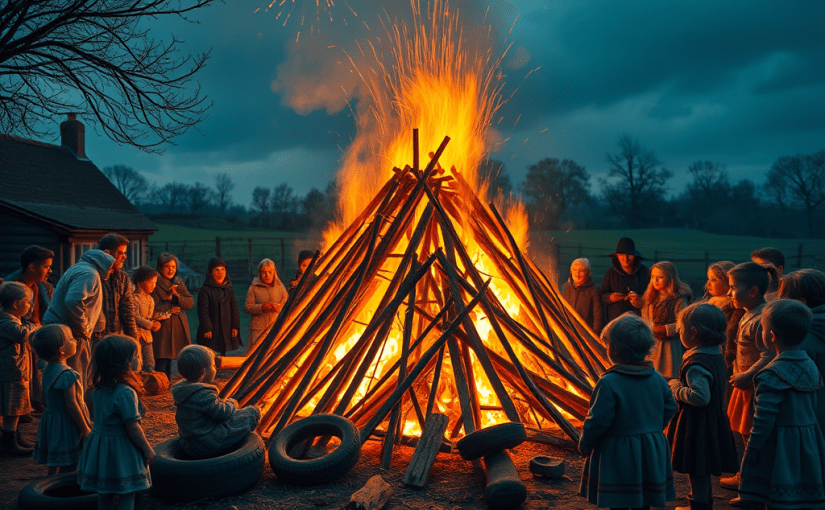
This month I celebrate a failure! In 1605 A chap called Guy Fawkes was caught whilst trying to blow up Parliament, and since then, we have turned his failure into an annual reason for making bonfires.
I am pre-war, and when it ended, we had to scavenge homes, sheds, gardens, allotments, and countryside to find things to make a Pyre. A prize acquisition was a bald tyre from a motor bike or even a car. Children scavenged hedgerows for broken posts and anything combustible. The grown-ups produced old, flattened mattresses after purchasing new ‘Sprung’ ones. Old hand-pegged rugs were thrown onto the pile as bare floorboards began to be covered with carpet squares.
I don’t recall burning anything made of plastic in those early years, and telegraph poles and railway sleepers were simply too useful to be burnt in celebration of an elected parliament.
I had only a vague sense that bonfires had something to do with Royalty, Catholics, and Parliamentary Protestants. My childish thoughts were of saving pennies to buy fireworks; and storing them in a bedroom drawer until bonfire night.
I expect it was dangerous, but experience of war inures you somewhat. However, I do recall excitement over thirty years ago during the Pauntley Bonfire; held on a small lane-side field next to Pauntley Place then owned by BrigadierBruno and Jaquie Elgood.
Tim England was the chief match striker, and I picture an upright lemonade bottle into which he placed the first upright rocket but; on ignition, the bottle fell over whereupon the rocket flew head high for 40yards directly into the galvanised dustbin containing all the fireworks purchased to provide the illuminatory entertainment for the evening.
The effect was brief but spectacular. The entire ten-minute firework display was condensed into 45 seconds within the confines of a galvanised lidless dustbin. Roman candles, bangers, jumping jacks Spinning Wheels and assorted rocketry exploded to form a cacophonous, gaseous, miasmic cloud over the whole field.
Tim and Eric Solesbury managed to dampen down the conflagration, but It was only after the melee eased, and survivors accounted for, that conversation reverted to roast chestnuts, cider, and Gloucester Market livestock prices. The evening ended to the hissing sound of rain gently falling on the dying embers of our unforgettable time with a latter-day Guy Fawkes.
That was long ago, and I now better understand the reasons behind the Gun Powder Plot and the turmoil amongst the ruling elites. The newly formed Church of England and the Monarchy managed to unite England at its highest constitutional. Intellectual and social level. But there was a cost.
Gone was the use of two foreign languages (French and Latin) which had divided the nation between its legal and educated level and its social level. This developing thousand-year-old nation was now umbilically attached to its own already sophisticated (Shakespearean) English language. As for its Religion:
Gone was the direct link to the Apostolic Succession of the first apostles who knew Jesus. Gone was the ancient understanding of the Sacrament of Communion based on the Greek Text in which the penitent man or woman could enter into the mysterious body of Christ. In its place, came an understanding based on the Latin text in which We ‘do’ things.
i.e. Instead of submersion into him, we take communion, we break the bread, we decide form and words and so on. So, in philosophical, theological and, psychological terms we moved from a concentrated focus on acceptance of the sacrificial Grace of God, to actions of our own will.
This change led the State and Church to root out Catholic practice and so, except during the reign of James II, it was not legal to worship as a Catholic until 1791. Civil rights were then fully restored in 1829. It is interesting though, that in 2025 the Catholic church now has more regular attendees in the UK than does the C of E, though not as many members on the books.
Finally, when reflecting on thoughts of Apostolic Succession, Eucharist/Mass, readers might want to consult Philosopher and Theologian Martin Buber, and his interesting insights when viewing other people from the perspective of both the I and the Thou.
Roll on December and “O Come all ye Faithful.”
 View from the Pew