
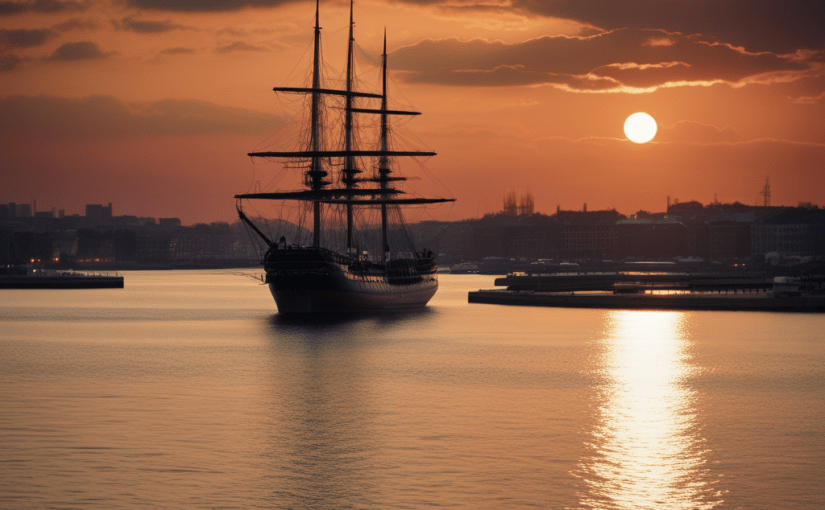
My earliest recorded ancestor Richard Wells was born in the vicinity of the Lincolnshire port of Boston in sixteen hundred and four, Recent research by a cousin mentions an intriguing historical situation that may have troubled him.
Between 1530 and 1780, approximately 1.25 million people from Britain, Ireland, and Mediterranean Europe were kidnapped and sold into slavery by North African traders who operated primarily from the coasts of North Africa.
The notorious Corsairs, as the Barbary traders were known, wreaked havoc on British shipping during this period and Admiralty records show that they plundered at least 466 vessels between 1609 and 1616, with an additional twenty-seven near Plymouth in 1625. Authorised by their governments, Barbary pirates targeted ships from all Christian countries including the British Isles. Their lateen-rigged xebecs and oared galleys facilitated the capture and subsequent sale of men, women, and children into slavery.
Historian Joseph Morgan noted a list from 1682 documenting the capture of 160 British ships by Algerians in just three years (1677–1680). The estimated number of able-bodied British men and women enslaved during this brief period alone, ranged from seven to nine thousand.
Beyond attacking sailors, the corsairs raided coastal settlements. They stealthily approached unguarded beaches, snatching victims from villages under cover of darkness. In 1631, nearly all the inhabitants of Baltimore, Ireland, fell prey to this method, as did coastal communities in Devon and Cornwall.
Samuel Pepys, in his diary entry from February 8, 1661, vividly recounts encounters with two men who had endured slavery. Captain Mootham and Mr. Dawes, both former slaves, shared harrowing details of their lives in Algiers. Their feet were beaten, and they subsisted on nothing but bread and water. Pepys’ matter-of-fact tone underscores the grim reality faced by unfortunate European people such as Mootham and Dawes in 17th-century Britain.
Interestingly, it was in 1745 that James Thompson 1700-1748 wrote the following words:
When Britain first, at heaven’s command,
Arose from out the azure main,
This was the charter of the land,
And guardian angels sung this strain—
“Rule, Britannia, rule the waves;
Britons never will be slaves.”
As our navy grew the Barbary slave trade declined until British politicians finally put a stop to slavery as an ‘amoral’ source of labour in 1833. At which point the Royal Navy enforced a ‘morally based worldwide’ ban..
The history of slavery was many thousands of years in the making and includes millions around Europe who suffered slavery by the State and in lowly servitude in households of some of the wealthy. As for the future, anyone who feels a need to pay reparations for something that took place before they were born, has a task demanding the wisdom of Solomon. To whom are reparations due? Is the payment to assuage guilt or to gain a tick in a box labelled Moral? I would rather show gratitude for one’s blessings by living a life whilst awake to the interests of others. (Note the present tense of awake rather than the past tense awoke.)
I am grateful to BBC sources and MSCopilot for some of the details above.
But talking of slavery of the body brings me to the slavery of the mind. Every now and then something occurs, and a turning point is reached. It happened recently whilst listening to YouTube interviews and lectures by Dr Iain McGilchrist. His books, The Master and his Emissary and The Matter with Things are easily readable and scholarly masterpieces on (my words) the slavery of the Brains right hemisphere, by its dominating left.
The right hemisphere, finds and comprehends everything, but is being overpowered by the apprehending left which ‘grabs and grasps‘ and which believes it is always ‘Right’ and asserts that its answers are correct and final. Incidentally the negative emotions such as hatred are also located here.
McGilchrist gets top rating by Guardian’s Shelley Vickers: “He persuasively argues that our society is suffering from the consequences of an over-dominant left hemisphere, losing touch with its natural regulative ‘master’ the right. Brilliant and disturbing. A Guardian Book of the Year.
This month’s View however is weighty and so for Lexophiles I leave you with a lighter touch:
I stayed up all night to see where the sun went, and then it dawned on me.
 View from the Pew