
Last month I mused on a distinction between how people ‘perceive’ the world around them and the ‘realities’ of that world. We get a good example of this distinction when we look at the reactions of people who are convinced they are going to ‘win’ something but in the end ‘lose.’ We can all remember the looks of disbelief on the faces of losing Politicians and Sportsmen alike as they gradually adjust to the realities of life.
It is particularly interesting to watch the reactions of losing politicians. They first usually deny the signals of defeat and then quickly start to blame the media or their opponents for misleading the electorate. It then usually takes a few days before they start to accept that the electorate simply did not want them or their manifesto.
Of course, politicians the world over rarely feel guilty about anything, and so soon get over any depression and quickly begin to point out the ‘perceived’ failings of opponents in the hope that the electorate will change its mind next time around.
However, it is not only Sportsmen and Politicians who must be careful that their perceptions do not deny reality. I guess we all have to look out just in case a particular perception happens to ‘freeze’ in our mind and so becomes fixed for all time.
Fortunately, the following account demonstrates how mental perceptions can be adapted to take account of physical realities without fatally damaging the original perception.
A couple of years ago we had a lovely holiday in north Norfolk and so a few weeks ago we took a cottage closer to Norwich. On the Sunday morning we made a surprise visit to St Andrews in Gorlestone-on-Sea in the hope of finding a charming 28 year old American girl we had last seen in 1970. My mind told me that the half Cherokee Julie had a wistful figure and long black hair; The Julie we met was a bent grey haired old lady who needed two sticks to get around. I had expected to see some changes but was not expecting the passage of 45 years to show such a visual difference.
I quickly realised that the grey hair and arthritic skeleton were irrelevant because Julie Stowe, now Julie King was the person we had known in our youth. It was also obvious that the kind hearted, sharing, talented and hard-working Julie we knew and loved was seen in the same way by the hundred plus congregation of her parish church.
Julie was still teaching Sunday classes, singing in the choir, running a literary group, a member of the WI and generally spending her time helping others to lead fulfilling lives. This also goes for her adopted family of two boys, four grandchildren and two great grandchildren.
In Julie’s case perception (how she looks) is definitely not the reality. Neither does she talk of her own discomforts and so, because of her example, I have to be on guard and make sure I deal with the real person and not a fixed mental image.
Norfolk is, of course, adjacent to Lincolnshire and Suffolk both of which produced their own breed of sheep. The Suffolk came about as a result of putting Southdown Tups onto Norfolk Horn ewes in the 1700s and gives a carcass of around 23kg. The Lincoln, which was bred for its wool and mutton, has been around since the 1300s and is the largest British Breed with tups up to 350kgs. But because the market for mutton and wool has dropped, it now costs more to shear the sheep than one gets for the wool and so breeds such as the Lincoln and Cotswold have declined in numbers. Even the Suffolk plays second fiddle to the tasteless foreign breeds loved by supermarkets because they are perceived by the eye to look better than the traditional breeds.
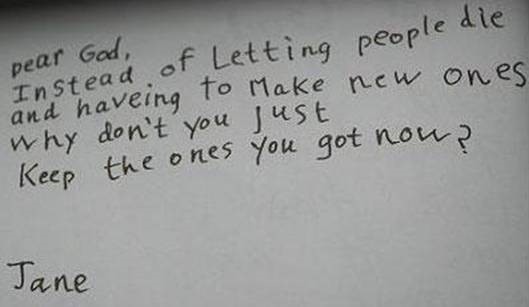
Finally, talking about how differences between ‘perception’ and ‘reality’ can cause confusion in a persons mind, makes me think of how children see life. One Sunday School child in particular tried to reconcile these differences when she wrote the following on a White Board:
 View from the Pew