
We can all start the New Year determined to enjoy a full English breakfast? Yes, I do mean a breakfast of black pudding, fried bread, eggs, bacon, sausage, hash brownies and mushrooms covered in HP sauce. Followed by toast smothered in English butter and ginger marmalade. Ending with coffee and cream.
In 2015 we can go ahead and enjoy ourselves again, and it’s all thanks to US scientists who concluded a study by saying that polyunsaturated fats are, in fact, good for us! New York University scientists followed their Cambridge University counterparts who, last March, reported that, “Giving up fatty meat, cream or butter is unlikely to improve health.”
These two studies found that saturated fat does not cause heart disease and that so-called ‘healthy’ polyunsaturated fats do not prevent cardiovascular problems. Lead researcher Dr Rajiv Chowdhury said, “These are interesting results that potentially stimulate new lines of scientific inquiry and encourage careful reappraisal of our current nutritional guidelines.”
Their report says that levels of the “so-called healthy” polyunsaturated fats omega 3 and omega 6 had no general reducing effect on the risks of heart disease. Omega 3 fatty acid found in oily fish was linked to a lower risk of heart disease, but omega supplements weren’t, and they concluded by saying that, “Alongside taking any necessary medication, the best way to stay healthy is to stop smoking, stay active, and ensure that our whole diet is healthy.
As expected, the latest reports caused outrage from those who claimed that these studies undermined their own belief that Mediterranean and vegetarian diets were the way forward. So maybe even if we can’t be certain local Dairy and Livestock farmers will have bumper sales in 2015, we can be sure that ‘food experts’ will continue to disagree.
Talking about what does you good however, reminds me that after breakfast Marie and I sit down with a cafétier of coffee and the Telegraph word puzzle. This has eight letters surrounding one in the middle and the task is to find as many words as you can in ten minutes. Today one of our words was Pinto. It being a horse with large splodges of white and another colour and which was ridden by Cowboys and Indians. But Pinto was not in the list of answers and its absence says something about how Britain is changing.
Other words we use are also missing. Poetic words such as doth, thinkest, thou, changeth, and listeth are absent, but as worrying are words from the industrial heartlands of British farming and manufacturing. Heald, Shog, Moiety, Peening, Pirn, Stenter, Wether and Wale are a few of the thousands of words describing processes or items associated with the products which were in the nineteen fifties made by the 71% of the population employed in making products for export.
Britain then also made the machines which made the products. Now we make few of those machines and worryingly, we do not make any of the equipment that sets the parameters and measures the tolerances of machines. We now buy ready made foreign production machines and have largely become a nation of assemblers rather than original primary engineers.
The ‘language’ of engineering has not disappeared however, as its terms have been seized by marketers and spin doctors to give an apparent stability and solidity to transient things. For example, we used to take money to the bank because they offered the service of putting some on deposit and lending the rest out to people with interest. Now they call this service a ‘product’ and instead of taking our money, they ‘sell’ us a bewildering range of bonds and accounts all marginally different. They then resell the ‘products’ we have bought to people who rename them sub-prime assets. They are then sold again to someone who calls them ‘derivatives.’ … By such means have our original solid coins become nebulous debts !
In my youth an honest engineering product had substance and did something useful. Now the language of engineering is used merely to give an image of solidity and authenticity to insubstantial transient concepts. It is not only the bankers and insurers however; politicians, quangoes, corporations, and local authorities are all at it. “It doesn’t matter” they tell us, ‘what the truth is. It is what people think it is.” …… If only I could believe them!
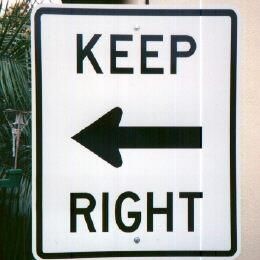
Mind you, they don’t help themselves, as this road sign from Bedford illustrates:
 View from the Pew