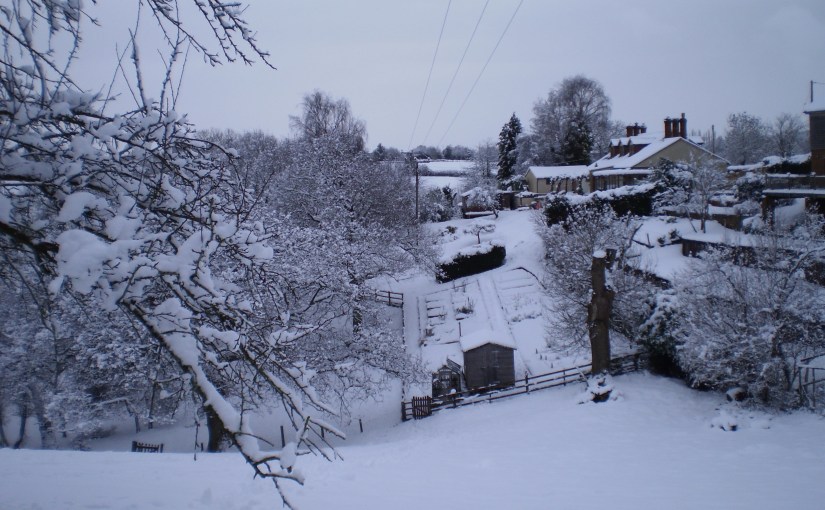
At the end of this month, we hope our ewes will give birth to a few lambs and although I keep saying that this year will be the last time, we just keep going. We sell lambs to local butchers and so recover the costs of feed and medicines. We also claim the cost of equipment against income tax, but labour, land and buildings have never figured in our spread sheets.
We keep going because we like sheep and because we feel that the traditions of our ancestors should be honoured and followed. To do this means also maintaining the local rural life and the rural landscape. It is important also to see the stars and to keep a night sky free from urban type lighting. Clear skies encourage our eyes to drift into the immensity of creation and so allow our minds to enter the awesome realms of wonderment at the mysteries of space and time. We are encouraged to marvel at the majestic complexity of creation. A creation which, despite our self-importance, can be said to liken us to a grain of sand. Our ancestors asked the question, “What is man, that thou art mindful of him?” and I guess this thought must have echoed in the minds of all the folk who now lie sleeping in our moonlit churchyards.
As I write this piece on the first day of 2021. I can say with confidence that I shall remember the ordinary people who, in 2020 selflessly cared for the sick whilst the organisation which employed them failed both the public and its own employees. It did so by fiddling the figures, shifting the elderly to care homes, giving the virus to a quarter of the people who went into hospital, and by failing to use the help offered by retired staff. I wonder, if this is a case of a top-heavy bureaucratic organisation failing to live up to the values, standards, and practices of those people it employs.
I shall also remember the way in which big city folk ran away from Covid19 by rushing to the countryside where many of them snapped up rural properties, without even seeing them.
Last year’s reactions to events helped me to see that the broadcast news media is unable to examine world events, and to then present a balanced and thoughtful view to its listeners. I found it difficult to see a source of hope and optimism within the incessant negativity and fear which poured from the highly paid and supposedly impartial newsrooms of TV and Radio. It did not therefore, surprise me to learn that millions turned elsewhere for news and information.
I did however see a great deal of gratitude being expressed by rural folk throughout last year, and a goodly number of home-grown vegetables being shared amongst neigbours. Many local small on-line businesses boomed, whilst others based in shops and pubs had a rough time. Hope however really does, “Spring eternal” and I, for one, will carry that belief forward.
As I talk of hope, I also realise how personal such a concept is. It is within a person. It is not an outside entity but is an active energic impulse within. Hope is alive within the person and can be seen by others. It is an attractive quality in a dark world and can, like a virus, be caught by others. I’m sure that when the scriptures talk of ‘light’ and darkness’ they had in mind the light of hope and the darkness of fear. In 1826 Bernard Barton the Quaker Poet from Northumberland wrote some of his thoughts in verse three of the following hymn:
“Walk in the light! and thou shalt see Thy darkness pass away,
Because the light has come to be, In which is perfect day.”
I seek out the company of people of hope and often find them in the little chapels and the forgotten churches, in the small businesses and small factories. These are the men and women of cheer who are often ignored by the ‘great and the good,’ (sic) but whose lives touch the ‘untouchables.’ They are a haven of warmth for the forgotten and many of them also run small local charities. It is these charities who need the donations presently hoovered up by the big advertising budgets of the global players. But, unlike the big boys, small charities won’t reward you with packs of glossy leaflets and cuddly toys. However, more of the money will be used for what it is intended.
I particularly like St Paul’s words: “Without hope I am of all men most miserable.” He of course, saw hope as eternal and not just transient to this world. So, it is with that in mind that I end February’s column with the thought that:
Every night we go to bed and set the alarm:
Now that is Hope.
 View from the Pew