Can it really be thirty Christmases since Marie and I joined Tim and Emma England, Eric and Anne Solesbury, Bruno and Jaquie Elgood and others in trudging the lanes of Pauntley singing Carols?
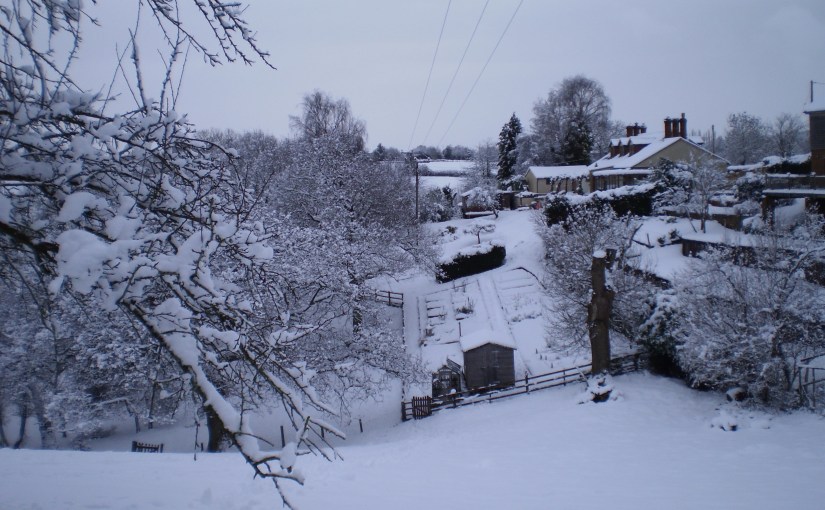
During these years, a lot of water has passed under the Ketford and Payford Bridges on its way to Maisemore where, for a short spell, it will become a minor current in the River Severn prior to losing its identity in the Atlantic Ocean. These years have also seen residents die, and others arrive. This is also true of the sheep, cattle and generations of rabbits, moles, badgers, and foxes. Even the woodlice inhabiting my wood stores can trace their ancestry back to the ones who lived around Ivy Cottage in 1830 – which was the name of our home until it was changed by a later owner.
Come to think of it; Ivy Cottage was an appropriate name, and I wish I had changed it back when we bought the holding from Allun Evans. I am told however that it is quite difficult to change property names nowadays. This does not surprise me as bureaucracy in every walk of life has multiplied to the extent that inertia is the norm, and so nothing can be changed until a crisis occurs. Panic, then reigns for a while.
Christmas is coming, as is the death of the old year and the birth of the new. Which brings me back to the River Leadon which dies, as its own identity is lost in the Atlantic. This in turn, reminds me that the Sadducees and Pharisees of the Old and New Testament had conflicting views of what happens to the soul of a person at death.
The Sadducees were a Jewish sect of the aristocratic elite. They were the majority in the Sanhedrin which was the Jewish government under Rome, and the High Priest was a Sadducee. As an elite they worked closely with the Romans to keep civil order, and it was they who ruled at the top end of Jewish social and religious life in the Temple. Sacrifices were made there and one of their teachings was that, on death the ‘individual person’ ceased to exist, and its soul went back to God. The Pharisee Sect on the other hand, led worship in local synagogues and were much closer to the people. They taught that the individual, and its immortal soul lives on in heaven after death.
The Scribes were the literate and lawyer class of Judaism and a sort of educated bureaucracy, and so both groups drew heavily on the historical and legal knowledge of the Scribes. Between them they produced tens of thousands of minutely detailed rules regulating all aspects of life. Many of which made life more difficult for people and were contradictory to other rules. (Sounds familiar?) The Temple was however destroyed by Titus and Tiberius in AD70 and so the Sadducee sect lost its purpose and disappeared, but the sect of the Pharisees morphed into the Rabbinical tradition which is at the core of local Judaism today.
However, as my mind continued to pursue the metaphor of how our own local river loses its identity in the Atlantic Ocean, and the Sadducees belief that the human soul loses its identity in the ‘ocean’ of its creator; I was prompted to remember many moments when singing chorus during concerts. Suddenly I would become aware that my voice was creating something which was altogether different from that which was possible from its own sound alone. It felt as “though I were myself whilst simultaneously being a part of another body, a wider creation.” The resultant sound and experience being wonderous, awesome, beautiful, unique, and emotional, but in scale and character quite different to the solo voice.
Is it I wonder, possible that such an experience can bring together the two contrarian possibilities for the soul after the body’s physical death? Are the two concepts of individual identity or its loss through absorption into an ocean, mutually exclusive? Or is it possible that the Christmas Baby made it possible that I can continue as an individual voice, but also sing as a member of the heavenly choir?
Whatever the eternal picture; I know only that I can ‘see through a glass darkly,’ and so Christmas, (lockdown or not) may be a time for some of us to list the assumption which that lies behind our thinking about birth and death and, having clarified our assumption, then ask if the assumption opens up the mind to new experience and new information, or has it already closed the mind off?
As for me: I want to sing with the solo voice and to add that voice as a drop in the ocean to the heavenly choirs.
Talking of which, I shall end this year as I do always, by asking readers to sing with me the words of Adeste Fidelis. (O Come all ye faithful) The penultimate verse being:
Sing, choirs of angels, sing in exultation
Sing, all ye citizens of heaven above!
Glory to God
Glory in the highest
O come, let us adore Him
O come, let us adore Him
O come, let us adore Him
Christ the Lord!
To see more Views type www.viewfromthepew.co.uk into the ‘search’ box of your search engine. Or, type https://viewfromthepew.co.uk into the address bar at the top of your computer screen.
When you are on the site, go to the left column and click View from the Pew.
 View from the Pew