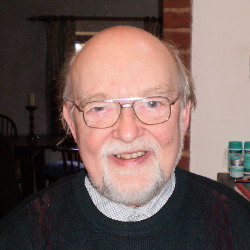

For sixty years in one capacity or another I have been involved in running and advising companies and often closing factories, and in every case during the proceedings someone has used the words, “People matter more than buildings.” And these words came into play again when it was thought possible some churches in this benefice might be closed.
As suggested by the title of this column I have a life-long interest in what Christian Churches and Christian organisations are up to. Put simply, they exist because a self-employed working class carpenter from a nondescript village realised that any ordinary person, could have a personal relationship with God. His idea was revolutionary and the ruling elites of the day realised immediately that if this idea took root, they could be bypassed and their livelihoods and sense of importance lost. (And which of us does not need to feel wanted and important?)
This ‘nobody’ carpenter was not from a city but a little village and although he taught from the same scriptures as did the ruling elites he did things differently. For a start, he mixed with the people, healed the sick and said that the Ten Commandments were to help people not to control them. But what irritated the rulers most was that he told them that they were the ones who wrote the rules and interpreted the commandments and that they did so to address their own concerns rather than the concerns of ordinary people. They even created rules that meant that it was difficult to spontaneously help people until certain permissions had been given. Their version of red tape irritated and stifled people and so in fear of their own jobs, various factional leaders whipped up crowds against him. They did what bad leaders the world over try to do. Ignore the ordinary man and his views and get rid of the ‘trouble makers.’ Their reasoning being, “It is better that one man die than the whole system be destroyed.”
Some readers might think this particular reasoning sounds like the teaching of modern utopians such as Marx, Hitler, Stalin, Mao tse Tung and Islamic State. It does, and it is because these people believed that systems are more important than an individual that they feel justified when sacrificing anyone who threatens their ‘ideal’ system. The Carpenter however was in no doubt. The system is there for the person not the person for the system.
However, back to the closure of churches and the saying that people matter more than buildings. Usually when I hear that phrase, the speaker uses a tone of moral finality suggesting that the statement is so obviously correct that no further discussion is necessary. But in my view such a didactic position does not justify a moral tone as it ignores two crucial aspects, one of human nature and the other of time.
Because the first instinct of every animal is survival and because, in most cases that threat is quickly settled and survival is assured (even if only for a short time), the instinct for shelter and food then quickly takes precedence. This explains why people build things and why, after eight thousand years, we have a huge physical legacy of buildings but scant evidence of the names of the people who built them.
In addition to shelters, the nameless ancestors whose DNA we carry, also built sports stadia in an attempt exert some control over competitive instincts and, because they have always felt the need to attune to what are called spiritual and esteem instincts, they built Temples. In Britain, Christian Buildings echo that ancient need and link our own lives to those early folk.
Throughout the Old Testament and other texts we are linked to the Hebrews, the Greeks and Romans, during which period this revolutionary carpenter was born in Galilee of Judea. It is his birth which led to the establishment of our unique European culture and which we celebrate each Christmas the same Parish Churches built by our ancestors and who left them to us. “Who today”, I ask will, by neglect or disinterest deny our unseen descendants the legacy left by our unseen ancestors?
In conclusion: In the third paragraph above, I mentioned how even simple rules can lead to outcomes not in the interest of the people who are expected to follow them and how some rules can lead to silly and serious outcomes. But an innocuous example was recently found by my wife on a body warmer in the Labels store at Ross on Wye.
Rural folk like this garment because it keeps the torso warm but leaves the arms free to move and so they are ideal for outdoor working. They are frequently thrown into the washing machine and so when my wife spotted a nice two tone warmer she was pleased to read the design label which said the jacket was ‘Reversible.’ However another label bamboozled her by its instruction which read ..…
Wash inside out.
 View from the Pew