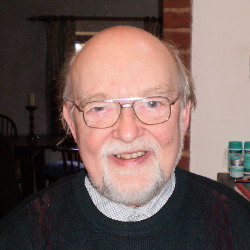
April is my birth-month and as this is my eighty-first, I hope readers will allow me to muse on a question that has entertained me for many years. It is, “Why do we give names to everything”?
The straight forward answer is of course, that the chemistry of the brain generates electricity, and this allows data to be stored so that it can be retrieved as soon as the mind wants it. The brain itself comes ready wired to create pictures diagrams and patterns. Thus, as children we learn that a large yellow, striped creature with a long tail is a Tiger and so on. When we start school our personal data-base grows and our teachers help us turn the data our senses pick up, into information. It is this information which then allows us to communicate with others who, themselves, understand data in the same way. Naming things is a bit like building a wall, in that it becomes the boundary of whatever it surrounds.
This is generally fine for those things we pick up from our senses and which we can see and measure; but starts to become complicated when we give names to concepts and ideas we cannot see, but exist only in our heads. The Greeks sorted out this complication by coming up with a discipline called Philosophy. This name then gave a substance to topics such as Ethics for those who love asking questions about how we should live. Likewise, Metaphysics for discussion about what sorts of things exist and what are their essential natures, and Epistemology for what counts as genuine knowledge and, of course, Logic to talk about what are the correct principles of reasoning. The Greeks thus gave us something we could call real and existing, despite there being no conventional means of direct measurement
To summarise; Putting names to those things we can see and measure is relatively easy as seen in physics, chemistry and mathematics. However, things such as Philosophy and Theology exist without external verifiable evidence in the physical world. I shall stop now as to take this discussion further might bore some readers, and so it is against a background of such weighty matters, that I now ask a light-hearted question as to why TV Weathermen have recently decided that infrequent natural meterlogical occurrences need to be named?
What is it about a three to four day bout of rain or sun, snow or hail that requires it to be named? Does calling it Henry, Ada, Matilda or Jasper make any difference to those poor souls who lose their homes? Come to think about it, What if an extended period of sunshine were to be called ‘Drought Abdullah’, might not this conjure up images of the Arabian desert and so incite hatred towards any Abdullah residing in Britain?
In fact, why should something that is already defined and is, by that definition, here today and gone tomorrow be given an added identity? Have the weather men simply pushed the logic of naming to an illogical conclusion, or has technology now made their job repetitive and boring to the extent that some lively lad or gal came up with the idea of spicing up their image on TV, by presenting ‘Hurricane Henry’ with a sombre face, or ‘Sunny Sandra’ with a sultry smile?
At the date of writing we are into the fourth month since the Corona Virus was identified in China. Most of the media coverage to-date has been speculative with a lot of ‘what if’s’. However, as more information is gathered and shared the media is now calming down and we are starting to hear informative discussion which balances risks and opportunities. Despair still has some way to run but hope is in the air. I guess we must accept the present situation and put fear behind us and look forward in hope.
But talking about accepting the ‘now’; Last night, I walked up the headland and looked into the dimly lit lambing shed to check on the last four pregnant ewes. They chewed cud and gazed quietly up at me as I chatted to them and wandered around the shed. I then sat down and thought of the thousands of shepherds over the ages who had shared such moments with their animals. Not one ewe was fearful or hopeful, none were contemplating the ‘what if’s. None were worrying about what they should wear or what they should eat, or whether their pension would see them out. Unafraid, unexcited, they had not been to a guru or psycho therapist to take away their worries or to help them to see things in perspective. They were in the state of what some now call ‘Mindfulness’. And I was with them.
I opened this article with some talk of nouns, and end it with adjectives as in noting that:
Models that leave the cat-walk are de-posed. Sacked Electricians are de-lighted and retired Philosophers become ex-pensive.
 View from the Pew