
The recent rugby win by Wales over England in in the Six Nations Trophy was greeted with a joy bordering on the ecstatic by the Welsh diaspora in the border counties and, for two weeks wherever I went, there were beaming cheerful Welsh faces eager to remind anyone with an English accent of the victory in Cardiff. Wales justifiably triumphed in a match in which the smart money was on England but turned out not to be so smart by the final whistle. Although English, I must confess a love of the Welsh people which is probably due to my extensively working throughout Wales for fifty years. In addition to a general musicality I have found Welsh folk to have sensitivity to what can only be called a ‘Spirit.’
Different people may interpret this is various ways, but I choose to use it in the sense of an openness of mind to what is going on in the hearts and minds of other people. It could be said to be a heightened awareness of something additional to what we get from the five senses of sight, sound, touch, smell and taste. But in this case it manifests itself in openness to the needs of others. Of course, there are exceptions to every generalisation but my own experience is that you do not have to talk to a Welshman or woman for very long before you are talking of the eternal verities of life that is, chatting about possible meanings, purpose, history and destiny of the individual.
A different perspective however, came from the Scotsman Bill Shankly who, whilst managing the football club Liverpool said, “Some people think football is a matter of life and death. I don’t like that attitude. I can assure them it is much more serious than that”.
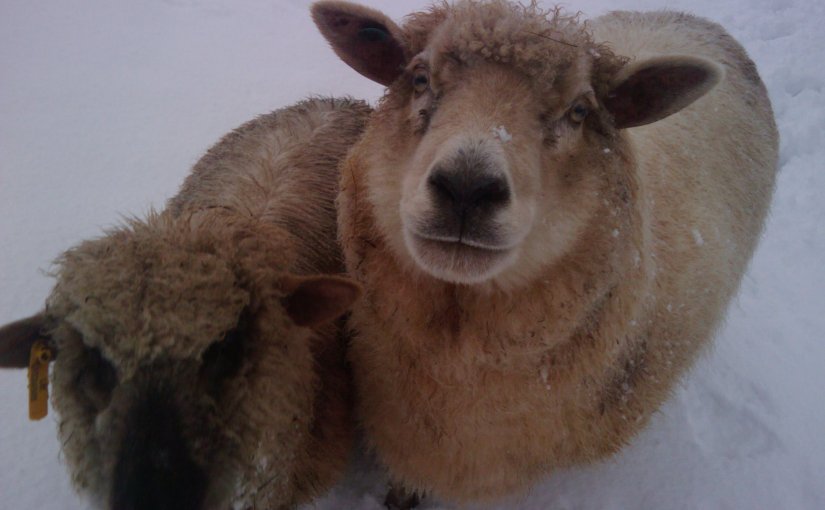
Talking about life and death however is something most rural folk are used to doing, especially during the first three months of the year when, according to the National Sheep Association, (NSA) Britain’s 16.24 million ewes are giving birth. It is often asked, “How many lambs on average does a ewe have”? Our own experience is from one to five but I believe six have been recorded. However as the ewe has two working teats nature appears to suggest that two is the maximum. I believe that in some mountain areas called Less Favoured land (LFA) the average is sometimes less than one, but on lower ground the national average is 1.65. Individual farm averages however will vary due to factors such as breed, location, condition of the tup and ewe, quality of feed and supplemental feeding and the availability of suitable minerals.bandry is critical especially if a shepherd is around during the time a ewe is in labour. Young ewes particularly may need some help to deliver and also lots of patience afterwards. Especially those which refuse to feed their lambs. However, we once had Dorset ewe, see pic above, named Spot who used to ‘belleck’ and stand in front of me waiting for her lambs to be pulled out. She was maybe too posh to push but after licking them thoroughly she would then walk over to an empty pen, turn around and wait for me to bring the lambs to her.
This year’s lambing went well and finally ended up topping-up only two. As I sat with one new Mum, I thought about the time when a visiting minister to the church read the twenty third psalm and spoke about the Good Shepherd. He didn’t realise that he knew less about sheep and shepherding than the congregation and the situation reminded me of the new school teacher who got a job in Cinderford. The Headmaster had primed her that the children of the Forest were, how shall we say, thick. And so, thinking to be clever, she walked into her first class and drew a detailed chalk picture of a sheep on the blackboard. She turned around and asked the eight year old’s what it was. All hands stayed down.
“Come come,” she said, ‘it’s obvious and there is no need to be shy.”
The hands stayed down.
Exasperated, she exclaimed, “O you must be thick it’s a sheep can’t you see what I’ve drawn”?
A little lad put up his arm,
“Oh we all know its sheep miss, but you see, yours has got the legs of a Southdown, the head of Cheviot, the ears of a Herdwick and the fleece of the Swaledale, but there’s no such breed.”
 View from the Pew